



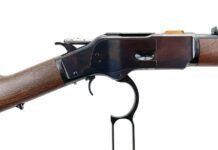






Lever-action rifles are woven into the fabric of our American culture. Many of these rifles were high tech when first introduced, offering rapid firepower. They were adopted by the military, used by lawmen and outlaws alike, and to this day are used by hunters and Cowboy Action shooters. Like all designs, however, older levergun designs were discontinued as newer and better leverguns were built. The thing is, you can’t put a good levergun down, to turn a phrase. Many great leverguns ceased production with their original makers only to be resurrected into production by other manufacturers that tweaked the design using newer, better materials, adding safety features, and chambering them in modern cartridges. Interest in the Old West and Cowboy Action Shooting prodded manufacturers to bring back production of these old rifles. Three of these resurrected rifles include the Henry New Original Henry, the Marlin Model 1894 Classic, and the Winchester Model 1873 Carbine.
How We Tested
The Marlin 1894 Classic is chambered in 44 Magnum and was run with 44 Magnum and 44 Special ammo. Both the Winchester and Henry were chambered in 45 Colt, aka 45 Long Colt. Bullet weight and shape can jam a lever action because the original designs were made to use a bullet with a rounded nose. Some modern bullet types and weights may have a hard time cycling in these guns. We could not test all the available bullets, so we want to temper expectations and make sure you test ammo before venturing on a hunt, competition, or using the ammo for protection. All of the rifles were fired using iron sights since the Winchester and Henry have no provision for an optic. The Marlin is drilled and tapped for an optic. Other than the open sights, common features include a tubular magazine, straight-grip wood stock, standard-size rectangular lever loop, and exposed hammer. From there, feature sets diverge. For example, the Henry is devoid of any modern safety devices, just a half-cock hammer and common sense. The Winchester uses a trigger stop and half-cock safety. The Marlin is equipped with a half-cock safety as well, and a push-button safety. We didn’t look at how close these guns are to the originals, because the point with a replica or clone is to be able to shoot the rifle in competition, at the range, or hunt with them. These rifles will not be accruing value like originals, and they are made to be used. Originals are best kept as safe queens.
We fired the three rifles from a bench using a rest at 50 yards and collected accuracy data from three-shot groups. Ammunition in 45 Colt consisted of Blazer aluminum-case ammo loaded with a 200-grain JHP, Hornady LEVERevolution with a 225-grain FTX bullet, Winchester Big Bore with a 250-grain semi-jacketed hollow point, Federal American Eagle with a 250-grain jacketed soft point, and Choice Ammunition’s cowboy load with a 250-grain round-nose flat point. In the Marlin, we fired 44 Special Hornady Custom with a 180-grain XTP bullet, and in 44 Magnum, we fired Sellier & Bellot with a 240-grain jacketed hollow point, Black Hills with a 240-grain SJHP bullet, and a SIG V-Crown with a 240-grain JHP. In addition, our test team fired the rifles offhand to assess how well they shouldered and what they offered in terms of fast follow-up shots.
We looked for ease in loading, smoothness of the action, serviceability of the iron sights, fit and finish, and accuracy. These are expensive rifles that offer an experience of what it was like to use a firearm 130 to 165 years ago and allowed us to check three boxes on our bucket list. You may want to check these off your list or even make room in your gun safe for one of these lever-action rifles. Others you might wonder why it was ever resurrected in the first place. In real life, it is not all Lonesome Dove and Open Range; lever guns have their own unique personalities, which we experienced running these guns. Here are the specifics in order of original introduction, starting with the Henry, then the Winchester and finally the Marlin.
Henry New Original Henry Model H011C 45 Long Colt
$2140
Gun Tests grade: A-
Shooting the New Original Henry is like taking a few steps backward in time. The lever was fairly smooth to operate, but cycling the lever interfered with point of aim, and the follower requires shooters to re-grip the rifle. Accuracy was excellent, depending on the ammo. The price is costly.
| Action Type | Lever, exposed hammer |
|---|---|
| Overall Length | 43.0 in. |
| Barrel | 24.5 in. long; 1:16 RH twist, blued steel |
| Overall Height | 7.7 in. |
| Weight Unloaded | 9.0 lbs. |
| Weight Loaded | 9.7 lbs. |
| Sight Radius | 21.7 in. |
| Receiver | Polished brass |
| Magazine Capacity | 13 |
| Magazine Type | Tube |
| Stock Material | Smooth fancy American walnut |
| Stock Drop at Comb | 2.2 in. |
| Stock Drop at Heel | 3.7 in. |
| Stock Buttplate | Brass |
| Stock Length of Pull | 14.0 in. |
| Front Sight | Blade |
| Rear Sight | Adjustable folding ladder |
| Trigger Pull Weight | 7.3 lbs. |
| Manual Safety | Half-cock notch |
| Warranty | Lifetime |
| Telephone | (866) 200-2359 |
| Website | HenryUSA.com |
| Made In | U.S. |
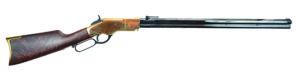
The New Original Henry is a replica of the Henry Model 1860, which was introduced in 1860. This iconic rifle was used by the Union troops during the War Between the States. Southern troops referred to the 16-shot rifle as “the rifle you could load on Sunday and shoot all week long.” In a time when single-shot muzzle loaders were the norm, the Henry offered unbelievable firepower. The original rifle was produced until 1866. Uberti produces a replica, as does Henry. Back in 1860, the Henry cost $40, which is equivalent to about $1521 in adjusted dollars today. The New Original Henry here costs $2140.
Our sample was chambered in 45 Colt and held 13 rounds in the magazine tube. It is also available in 44-40 Winchester; good luck finding ammo in that chambering. The first Henry 1860s were chambered in 44 Henry Rimfire, a shorter, less-powerful round, hence the 16-round magazine. What makes the Henry stand out from other lever actions is the polished brass receiver and long barrel without a fore end. And, yes, extended shooting heats up the barrel and makes it hot to the touch. In hand, the New Henry Original is long and heavy due to the 24.5-inch octagon barrel. It feels skinny in hand. The barrel is brightly blued and the corners of the octagon barrel were not very sharp, but slightly rounded. They were consistent, however. The magazine tube and barrel are one piece, with the magazine tube slotted for a follower. To load the Henry, the brass follower needs to compress the magazine spring into the barrel sleeve, and the sleeve rotated to the right side of the barrel, where the follower and spring are captured by a set screw. Loading the Henry requires the rifle muzzle to be pointed upward, then cartridges are dropped into the tube with the bullet end facing up. Once loaded, the Henry’s magazine sleeve is rotated back, the follower is eased onto the cartridges so it doesn’t hammer the top cartridge bullet into its case, making the cartridge dangerous to use.
Iron sights consisted of a wide blade front sight left in the white, meaning it is not finished. It is screwed onto the muzzle and held in place by a steel strap, like originals. It contrasted with the blued rear ladder sight. When folded, the rear sight offers a square notch. Flip up the ladder rear sight, and there is a V-shaped notch with elevation marks ranging from 3 to 8, indicating 300 yards to 800 yards. Wishful thinking unless you are Augustus “Gus” McCrae in Lonesome Dove. The ladder sight rests on a tiny rubber bubble when folded; obviously a modern fix so the folded rear sight does not scratch the top of the barrel. It’s a worthwhile addition, in our view.
You can see your reflection in the brightly-polished brass receiver. The top of the receiver is open with no dust cover. The hammer, lever loop, and trigger are blued. A lever hook needs to be rotated to allow the lever to cycle. This hook ensures the lever is fully closed during transport. The loop is a traditional oblong shape that is small when wearing bulky gloves. The nicely checkered hammer spur offers a sure grip to cock the rifle. The hammer has three positions: fully forward, half cock, and fully rearward. Half cock is the “safety” mode for the hammer. Place the hammer on half cock when carrying the New Original, and also use common sense. When the hammer is fully forward, it blocks the sights, telling the user the rifle is not ready to be fired.
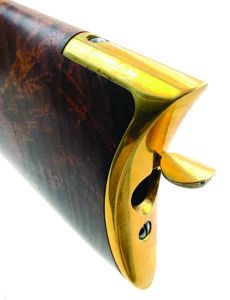
The stock is made of fancy American walnut that was nicely fitted to the brass receiver and the brass crescent-shaped buttplate. A small door in the buttplate provides access to a compartment in the stock, which was used to store a disassembled cleaning rod back in the day.
Shooting the New Original was a bunch of fun. Twisting the sleeve and follower was easy to perform. Loading, too, was simple, but you need gravity’s help. Initially, the lever was stiff to cycle and felt like a new pair of leather boots. The action slicked up with use, but there was some resistance at the final portion of the forward stroke as the carrier comes into position and the bolt pushes against the face of the hammer. The bolt pushing against the hammer face caused the resistance. This is inherent in the design. The rearward stroke cycled smoother. Briskly cycling the loop on the New Original is best practice, though we tried to jam the Henry by slowly cycling the lever. The New Original didn’t fail us.
Settling behind the New Original, accuracy at 50 yards with open sights made us grin. Our best three-shot group measured 0.53 inches with Blazer ammo; average was 0.97 inches. How’s that for shooting, Gus McCrae? Winchester Big Bore and Hornady LEVERevolution both had a best three-shot group that measured 1.36 inches. The Winchester averaged 1.39 inches and the Hornady measured 1.73 inches. The New Original was not partial to Federal American Eagle; best was 2.23 inches and average was 2.29 inches. The Henry shot about 3 inches high at 50 yards with the rear sight folded. Windage was dead on. A brass punch and hammer are needed to gently tap the rear sight left or right to adjust windage. The rear and front sights had a nice contrast and were serviceable.
The trigger was a heavy 7.3 pounds, but there was no creep in the movement, and it broke crisply.
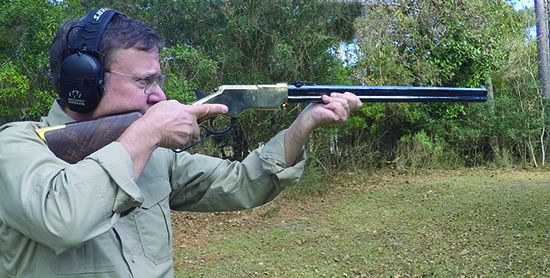
Shooting off hand, you notice the 9-pound heft of the New Original. It is a lot heavier than it looks. Recoil was nil. As the lever loop is cycled, empty cases are ejected up and over your head. We cycled the New Original briskly to manage the bolt/hammer resistance, which interfered with aiming and slightly slowed down follow-up shots. As the rifle is fired and cycled, the follower moves rearward toward the receiver as it pushes cartridges on the carrier inside the receiver. The follower interferes with your support hand hold, requiring you to re-grip the rifle with the support hand to allow the follower to pass by. Firing full magazine tubes of rounds, the barrel heated up. Wearing a glove on your support hand is a good idea for extended sessions. The New Original ran perfectly with all the ammo cycled through it.
Our Team Said: The New Original was a hoot to shoot. It handled differently than a typical lever action, but that is the charm or bane, depending on your opinion, when shooting older guns. The cost of the Henry is steep, but what you get is a beautiful rifle that performs like a rifle from the 1860s, but chambered in a more powerful modern caliber. A test team member used the Henry New Original and Hornady LEVERevolution ammunition on a wild boar hunt and found the New Original was effective on driven pigs. He filled his freezer.
| 45 COLT RANGE DATA | ||
|---|---|---|
| Blazer* 200-grain JHP | Henry New Original Henry | Winchester Model 1873 Carbine |
| Average Velocity | 1230 fps | 1153 fps |
| Muzzle Energy | 671 ft.-lbs. | 590 ft.-lbs. |
| Smallest Group | 0.53 in. | 0.50 in. |
| Average Group | 0.97 in. | 0.83 in. |
| Hornady LEVERevolution 225-grain FTX | Henry New Original Henry | Winchester Model 1873 Carbine |
| Average Velocity | 1142 fps | 1057 fps |
| Muzzle Energy | 652 ft.-lbs. | 559 ft.-lbs. |
| Smallest Group | 1.36 in. | 1.65 in. |
| Average Group | 1.73 in. | 1.97 in. |
| Winchester Big Bore 250-grain SJHP | Henry New Original Henry | Winchester Model 1873 Carbine |
| Average Velocity | 1118 fps | 1088 fps |
| Muzzle Energy | 694 ft.-lbs. | 657 ft.-lbs. |
| Smallest Group | 1.36 in. | 2.21 in. |
| Average Group | 1.39 in. | 2.23 in. |
| Federal American Eagle 250-grain JSP | Henry New Original Henry | Winchester Model 1873 Carbine |
| Average Velocity | 1180 fps | 1147 fps |
| Muzzle Energy | 773 ft.-lbs. | 730 ft.-lbs. |
| Smallest Group | 2.23 in. | 0.66 in. |
| Average Group | 2.29 in. | 0.69 in. |
| Choice Ammunition 250-grain RNFP | Henry New Original Henry | Winchester Model 1873 Carbine |
| Average Velocity | 1051 fps | 1045 fps |
| Muzzle Energy | 613 ft.-lbs. | 606 ft.-lbs. |
| Smallest Group | 2.37 in. | 2.25 in. |
| Average Group | 2.47 in. | 2.50 in. |
To collect accuracy data, we fired three-shot groups from a bench using a rest. Distance: 50 yards with open sights. We recorded velocities and energies using a Garmin Xero C1 Pro Chronograph. *Aluminum cases.
| 44 SPECIAL/44 MAGNUM RANGE DATA | ||||
|---|---|---|---|---|
| Marlin Classic Model 1894 | 44 Special Hornady Custom 180-grain XTP | 44 Magnum SIG Sauer V-Crown 240-grain JHP | 44 Magnum Sellier & Bellot 240-grain JHP | 44 Magnum Black Hills 240-grain SJHP |
| Average Velocity | 1100 fps | 1633 fps | 1381 fps | 1536 fps |
| Muzzle Energy | 484 ft.-lbs. | 1421 ft.-lbs. | 1017 ft.-lbs. | 1257 ft.-lbs. |
| Smallest Group | 0.34 in. | 2.53 in. | 1.07 in. | 0.56 in. |
| Average Group | 0.73 in. | 2.67 in. | 1.31 in. | 1.11 in. |
Written and photographed by Robert Sadowski, using evaluations from Gun Tests Team members. GT