


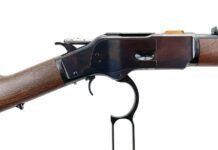





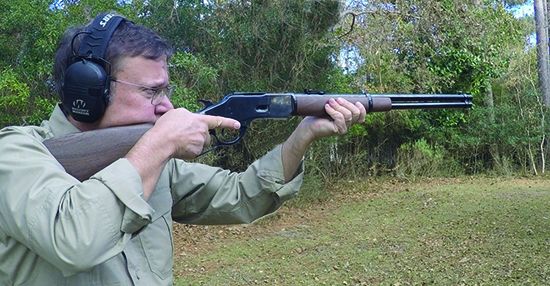
Lever-action rifles are woven into the fabric of our American culture. Many of these rifles were high tech when first introduced, offering rapid firepower. They were adopted by the military, used by lawmen and outlaws alike, and to this day are used by hunters and Cowboy Action shooters. Like all designs, however, older levergun designs were discontinued as newer and better leverguns were built. The thing is, you can’t put a good levergun down, to turn a phrase. Many great leverguns ceased production with their original makers only to be resurrected into production by other manufacturers that tweaked the design using newer, better materials, adding safety features, and chambering them in modern cartridges. Interest in the Old West and Cowboy Action Shooting prodded manufacturers to bring back production of these old rifles. Three of these resurrected rifles include the Henry New Original Henry, the Marlin Model 1894 Classic, and the Winchester Model 1873 Carbine.
How We Tested
The Marlin 1894 Classic is chambered in 44 Magnum and was run with 44 Magnum and 44 Special ammo. Both the Winchester and Henry were chambered in 45 Colt, aka 45 Long Colt. Bullet weight and shape can jam a lever action because the original designs were made to use a bullet with a rounded nose. Some modern bullet types and weights may have a hard time cycling in these guns. We could not test all the available bullets, so we want to temper expectations and make sure you test ammo before venturing on a hunt, competition, or using the ammo for protection. All of the rifles were fired using iron sights since the Winchester and Henry have no provision for an optic. The Marlin is drilled and tapped for an optic. Other than the open sights, common features include a tubular magazine, straight-grip wood stock, standard-size rectangular lever loop, and exposed hammer. From there, feature sets diverge. For example, the Henry is devoid of any modern safety devices, just a half-cock hammer and common sense. The Winchester uses a trigger stop and half-cock safety. The Marlin is equipped with a half-cock safety as well, and a push-button safety. We didn’t look at how close these guns are to the originals, because the point with a replica or clone is to be able to shoot the rifle in competition, at the range, or hunt with them. These rifles will not be accruing value like originals, and they are made to be used. Originals are best kept as safe queens.
We fired the three rifles from a bench using a rest at 50 yards and collected accuracy data from three-shot groups. Ammunition in 45 Colt consisted of Blazer aluminum-case ammo loaded with a 200-grain JHP, Hornady LEVERevolution with a 225-grain FTX bullet, Winchester Big Bore with a 250-grain semi-jacketed hollow point, Federal American Eagle with a 250-grain jacketed soft point, and Choice Ammunition’s cowboy load with a 250-grain round-nose flat point. In the Marlin, we fired 44 Special Hornady Custom with a 180-grain XTP bullet, and in 44 Magnum, we fired Sellier & Bellot with a 240-grain jacketed hollow point, Black Hills with a 240-grain SJHP bullet, and a SIG V-Crown with a 240-grain JHP. In addition, our test team fired the rifles offhand to assess how well they shouldered and what they offered in terms of fast follow-up shots.
We looked for ease in loading, smoothness of the action, serviceability of the iron sights, fit and finish, and accuracy. These are expensive rifles that offer an experience of what it was like to use a firearm 130 to 165 years ago and allowed us to check three boxes on our bucket list. You may want to check these off your list or even make room in your gun safe for one of these lever-action rifles. Others you might wonder why it was ever resurrected in the first place. In real life, it is not all Lonesome Dove and Open Range; lever guns have their own unique personalities, which we experienced running these guns. Here are the specifics in order of original introduction, starting with the Henry, then the Winchester and finally the Marlin.
Winchester Model 1873 Carbine 534255141 45 Long Colt
$1317
Gun Tests grade: A (OUR PICK)
In hand, the Model 1873 Carbine is lithe and lively. Being relatively light weight at 7.2 pounds unloaded, it shoulders fast and is easy to point. It offers a velvety slick action, had excellent accuracy with iron sights, and is a modern version of the gun that won West. We want one.

| Action Type | Lever, exposed hammer |
|---|---|
| Overall Length | 43.0 in. |
| Barrel | 24.5 in. long; 1:16 RH twist, blued steel |
| Overall Height | 7.7 in. |
| Weight Unloaded | 9.0 lbs. |
| Weight Loaded | 9.7 lbs. |
| Sight Radius | 21.7 in. |
| Receiver | Polished brass |
| Magazine Capacity | 13 |
| Magazine Type | Tube |
| Stock Material | Smooth fancy American walnut |
| Stock Drop at Comb | 2.2 in. |
| Stock Drop at Heel | 3.7 in. |
| Stock Buttplate | Brass |
| Stock Length of Pull | 14.0 in. |
| Front Sight | Blade |
| Rear Sight | Adjustable folding ladder |
| Trigger Pull Weight | 7.3 lbs. |
| Manual Safety | Half-cock notch |
| Warranty | Lifetime |
| Telephone | (866) 200-2359 |
| Website | HenryUSA.com |
| Made In | U.S. |
The Model 1873 was built by Winchester from 1873 through 1923, which is a long production run considering other, more-modern Winchester lever-action rifles were being produced. When Oliver Winchester took control of the New Haven Arms Company, he renamed it Winchester Repeating Arms Company and reworked the Henry Model 1860 into the Winchester Model 1866, called the Yellow Boy, as it used a brass receiver like the Henry. The Model 1873 evolved from the Model 1866, and became one of the most popular, famous, and iconic rifles ever built. Winchester marketed the ‘73 as “The Gun That Won the West.” The Model 1873 was available in a number of variants — carbine, short rifle, rifle, sporting, musket — with different stocks and barrel configurations and all chambered in Winchester offerings: 32-20 Winchester Center Fire, 38-40 WCF, and 44-40 WCF. As Cowboy Action Shooting was heating up in the late 20th century, Uberti started making Model 1873 rifles in 1995. In 2013, Winchester re-introduced the Model 1873 and offers models that range from plain to deluxe. Our sample was a Model 1873 Carbine in 45 Colt. It is also available in 44-40 WCF and 357 Magnum. Original ‘73s were never chambered in 357 Magnum or 45 Colt.
In hand, the Model 1873 Carbine is lithe and lively. Being relatively light weight at 7.2 pounds unloaded, it shoulders fast and is easy to point. The Carbine is equipped with a round 20-inch barrel; a barrel band holds the fore end in place. The fore end is thin in hand. The metal finish was a mirror-polished blue, quite handsome. The smooth wood is black walnut. Wood-to-metal fit was excellent. Back in the day, the ’73 incorporated new features like a wood fore end to protect fingers from the heated barrel during extended shooting and a side port to load cartridges into the magazine tube. The receiver is steel with side plates and a dust cover that opens when a cartridge is ejected. Empty cases are ejected up and over the shooter’s head, as long as you briskly cycle the loop lever.

Sights consist of a brass front blade and a folding ladder-style rear sight. When folded, the rear sight has a U-shaped notch to align the front blade. The front and rear sights contrast nicely. Flip up the ladder, and there are graduations marked 0 to 20.
The lever loop is traditional in size, so it’s a little small when wearing bulky gloves. A lever lock is rotated to keep the lever in place when transporting the Carbine. The blued-steel butt plate is smooth and comfortable when shouldering. No snagging on clothing. The top tang of the receiver is drilled and tapped to attach a vernier-type rear sight. We think that would be overkill on a carbine, but a ’73 with a 24-inch barrel is another story. The gate on the right side of the receiver allows for easy and smooth loading of cartridges, with no sharp edges shaving your thumb nail. Capacity is 10 rounds in the magazine. On the left side of the receiver is a saddle ring, known as a rattle ring when hunting deer because they always makes noise at the worst time. The trigger is wide and smooth, while the hammer spur wears fine texturing for a sure grip when thumbing back the hammer.
The hammer has three positions: fully forward, half cock, and fully rearward. The half-cock position can be used a “safety.” The other “safety” built in is the trigger stop. The lever stop prevents the trigger from being pulled unless the lever is held against the frame. The action cycled like velvet, slick and smooth. The hammer contour is different than the Henry’s, so there is less resistance as the bolt is cycled rearward to cock the hammer. A fully forward hammer blocks the sights, alerting the user the rifle is not ready to be fired.
The trigger has two stages, light take up until you hit the wall, then a clean, crisp break. Trigger pull measured 4.9 pounds.
We grinned even wider during accuracy testing of the Carbine. The best three-shot group measured 0.5 inch with the 200-grain Blazer ammo; average was 0.83 inches. Second best was with Federal American Eagle loaded with a 250-grain bullet, which measured 0.66 inch; average was 0.69 inch. Third best was the 225-grain Hornady LEVERevolution with 1.65 inches and an average of 1.97 inches. Winchester Big Bore had a best group of 2.21 inches and averaged 2.23 inches. We thought accuracy was excellent with Blazer and Federal ammo. The relatively lighter trigger pull on the Carbine no doubt helped with the small groups. We noted the Carbine shot 6 inches high at 50 yards, which was easy enough to deal with, though we wish there has a stepped elevator to adjust elevation. Windage was dead on. Tap the Winchester’s rear sight left or right with a brass punch to adjust windage.
Shooting offhand, we found the Carbine cycled super silky and hardly interfered with aiming. No wonder many CAS competitors opt for the ’73. There were no jams or accidental short stroking the ’73. Depressing the trigger stop was made easy because the spring tension on the trigger stop was light and took minimal effort to depress.
Our Team Said: Shooting the Model 1873 Carbine is pure joy. It cycled smoothly, recoil is minimal, sights are traditional yet serviceable. The Carbine is costly, but it performed exceptionally. If you need your own Gun That Won The West, this Winchester re-introduction is worth the cost of ownership. It is Our Pick of these rifles.
| 45 COLT RANGE DATA | ||
|---|---|---|
| Blazer* 200-grain JHP | Henry New Original Henry | Winchester Model 1873 Carbine |
| Average Velocity | 1230 fps | 1153 fps |
| Muzzle Energy | 671 ft.-lbs. | 590 ft.-lbs. |
| Smallest Group | 0.53 in. | 0.50 in. |
| Average Group | 0.97 in. | 0.83 in. |
| Hornady LEVERevolution 225-grain FTX | Henry New Original Henry | Winchester Model 1873 Carbine |
| Average Velocity | 1142 fps | 1057 fps |
| Muzzle Energy | 652 ft.-lbs. | 559 ft.-lbs. |
| Smallest Group | 1.36 in. | 1.65 in. |
| Average Group | 1.73 in. | 1.97 in. |
| Winchester Big Bore 250-grain SJHP | Henry New Original Henry | Winchester Model 1873 Carbine |
| Average Velocity | 1118 fps | 1088 fps |
| Muzzle Energy | 694 ft.-lbs. | 657 ft.-lbs. |
| Smallest Group | 1.36 in. | 2.21 in. |
| Average Group | 1.39 in. | 2.23 in. |
| Federal American Eagle 250-grain JSP | Henry New Original Henry | Winchester Model 1873 Carbine |
| Average Velocity | 1180 fps | 1147 fps |
| Muzzle Energy | 773 ft.-lbs. | 730 ft.-lbs. |
| Smallest Group | 2.23 in. | 0.66 in. |
| Average Group | 2.29 in. | 0.69 in. |
| Choice Ammunition 250-grain RNFP | Henry New Original Henry | Winchester Model 1873 Carbine |
| Average Velocity | 1051 fps | 1045 fps |
| Muzzle Energy | 613 ft.-lbs. | 606 ft.-lbs. |
| Smallest Group | 2.37 in. | 2.25 in. |
| Average Group | 2.47 in. | 2.50 in. |
To collect accuracy data, we fired three-shot groups from a bench using a rest. Distance: 50 yards with open sights. We recorded velocities and energies using a Garmin Xero C1 Pro Chronograph. *Aluminum cases.
| 44 SPECIAL/44 MAGNUM RANGE DATA | ||||
|---|---|---|---|---|
| Marlin Classic Model 1894 | 44 Special Hornady Custom 180-grain XTP | 44 Magnum SIG Sauer V-Crown 240-grain JHP | 44 Magnum Sellier & Bellot 240-grain JHP | 44 Magnum Black Hills 240-grain SJHP |
| Average Velocity | 1100 fps | 1633 fps | 1381 fps | 1536 fps |
| Muzzle Energy | 484 ft.-lbs. | 1421 ft.-lbs. | 1017 ft.-lbs. | 1257 ft.-lbs. |
| Smallest Group | 0.34 in. | 2.53 in. | 1.07 in. | 0.56 in. |
| Average Group | 0.73 in. | 2.67 in. | 1.31 in. | 1.11 in. |
Written and photographed by Robert Sadowski, using evaluations from Gun Tests Team members. GT