













Introduced by Winchester in 1959, the 22 Winchester Magnum Rimfire (WMR) cartridge, more commonly called 22 Magnum, was designed to bridge the difference between the popular 22 LR rimfire cartridge and more powerful and expensive 22-caliber centerfire rounds. On the low end of the spectrum, the ubiquitous 22 LR can usually push a 30- to 40-grain bullet at 1000 to 1200 fps. On the opposite end, centerfire rounds ranging from the 22 Hornet to the 220 Swift can send 40- and 50-grain bullets anywhere from 2400 to 4000 fps. In between, the 22 WMR round will push a 30- to 40-grain bullet out at 1800 to 2100 fps. Then we ran the energy numbers and found out the diminutive 22 WMR could generate energy approximately equal to a decent 9mm Luger pistol round at those speeds. With newfound respect for the cartridge, we started shopping for rifles chambered in 22 Magnum.
In this feature, we present three different 22 Magnum rifles with three different feature sets and three different price points. The first is a Christensen Arms MPR Rimfire that is truly match worthy but arrives at a near $2k cost. A Ruger American comes in at a much better price, but it is more suited to a life of roaming the woods looking for squirrels and varmints. The third entry is a Savage Minimalist, available at an even better price for what might be a truck or saddle gun.
In more detail, the MPR Rimfire from Christensen Arms, $1726, sports a folding aluminum chassis, full-length slotted fore end, and a Trigger Tech trigger. The MPR Rimfire is designed for competition and any other precision work you need. Second is the Ruger American 08370, $490, which offers a polymer stock with removable pieces that can provide a proper length of pull and cheek height for most needs. Last is a Savage rifle called the Minimalist, and it is. Weighing in at a mere 5.25 pounds loaded, the little Savage Minimalist handles well and was very accurate, we found. Interestingly, all three of these 22 Magnum rifles are threaded for suppressor use, though we didn’t shoot them with a can.
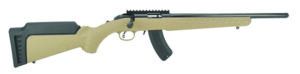
Ruger American Rimfire AMER-RF-T-FDE 08370 22 WMR,
$490
GUN TESTS GRADE: B+ [best buy]
Lighter and a lot less expensive than the Christensen, we found the Ruger American in 22 Magnum eminently suitable for field work or fun, though not quite as accurate as the MPR.
| Action Type | Bolt |
|---|---|
| Overall Length | 35.0 in. |
| Barrel | 16.1 in. long, 1:14 twist |
| Overall Height w/o Scope Mount | 7.25 in. |
| Weight Unloaded | 5.6 lbs. |
| Weight Loaded | 6.1 lbs. |
| Sight Radius | NA |
| Action Finish | Satin blue |
| Barrel Finish | Gloss blue |
| Magazine Capacity | 15 |
| Magazine Type | Ruger detachable box |
| Stock | Polymer |
| Stock Drop at Comb | 0.5 in. |
| Stock Drop at Heel | 0.5 in. |
| Stock Bedding | Ruger Power Bedding |
| Stock Buttplate | Hard polymer |
| Stock Length of Pull | 13.75 in. |
| Receiver Scope-Base Pattern | Ruger, Picatinny rail |
| Trigger Pull Weight | 3.34 lbs. |
| Safety | Two-position tang |
| Warranty | None Written |
| Telephone | (336) 949-5200 |
| Website | Ruger.com |
| Made In | U.S. |
Lighter and a lot less expensive than the Christensen, we found the Ruger American in 22 Magnum eminently suitable for field work or fun, though not quite as accurate as the MPR.
We’ve used a Ruger American 22 LR as a training aid with young shooters for most of a decade. Paired with the Redfield Battlezone scope we used for this test, the Ruger has been simple to adjust for those little guys and gals, while proving to be robust for instructors who tend to ask a lot from their tools. We’ve been looking forward to seeing how this 22 Magnum version would compare to the 22 LR version we’ve used and abused for a long time.
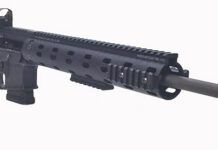
This FDE-colored Ruger American carries some of the same features of that little 22 LR. The polymer stock is found across many of Ruger’s platforms, and they have served well in the rimfire lines. Molded with strong cross-sectional ribs, the fore end tends to be stiff. We could squeeze it enough to make it contact the barrel, but just shooting it from a sandbagged rest would surely leave that barrel free-floated. The sides of the fore end are contoured with stippling and flats on the upper side that make for a secure purchase. The grips are also stippled and molded with a nice palm swell and a red Ruger logo.
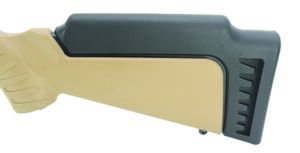
The buttstock provides a simple way to adjust cheek height and length of pull. The rear of the stock is two pieces, with one of those being removable. Unscrew the rear sling-swivel stud and the top piece can be pulled off. Our sample came with an insert that has a riser to help bring the face up to proper scope height. It is also the longer-length-of-pull version. Additional inserts with a shorter LOP and/or no cheek riser are available from the Ruger website. The system is simple and pretty much user proof. Just don’t lose the sling swivel stud.
Other parts of this stock remind us of the more expensive Christensen stock. The trigger guard is big, but not too big. The mag release is a lever located between the trigger guard and the magazine, where it is easy to access and still secure. The cut for the magazine is simple in design. And Ruger uses well-proven Ruger magazines, of course. Ours came with the 15-round BX-15 mag, which worked perfectly.
The 16.1-inch-long cold hammer-forged tube carries a 1:14 twist like the Christensen, but the Ruger’s is all steel. It sports a medium profile like the one used on the Predator series and is capped with 1⁄2×28 threads. It ships with a thread protector installed that has flats on the side for easy removal. The finish is listed as Satin Blue in the Ruger literature, but we are going to quibble with that. The action has a satin finish, but the barrel has a gloss look.
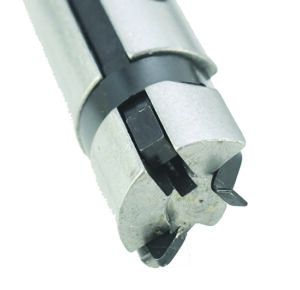
The action continues the Ruger look with an open-bridge design that sports flats on the upper edges. A 30-MOA Picatinny rail is installed in case you do want to push the range with this rifle. This rifle uses the Ruger Marksman Adjustable trigger as expected. It is a true single-stage unit, but we tend to run this safety-blade/trigger combo as a two-stage trigger, with the pressing of the safety blade being our first stage. Average required compression was 3.34 pounds, which we would like to see a bit lighter. The bolt handle is a little longer than normal and the bolt knob a little larger, making it very easy to run the bolt, especially since it only requires a 60-degree throw. As with the Christensen, the ejector is a piece fixed inside the receiver. The Ruger bolt is a little different in that it uses a single-sided extractor with a clip on the offside to make sure the cartridge case stays in firm contact with the extractor. The bolt release is a lever on the left rear of the receiver, and the safety is a two-position piece on the tang.
The interface between the stock and the action is pure Ruger. Two horizontally opposing pieces of steel are inserted into the stock at an angle. Those then fit into two mortises in the action, and everything is tightened down. They call this patented system a Power Bedding Block, and we have seen it work well in a number of Ruger rifles.
The Ruger American 22 Magnum fed and functioned perfectly, but it wasn’t quite as accurate as the other two rifles. The average across the three loads was 0.694 inch, with the Speer Gold Dot leading the race with a 0.615-inch average. That still translates to a 1.33-MOA rifle, which we think is very respectable for non-match rimfire ammunition.
Our Team Said: We selected the Christensen as Our Pick, and we stand by that. But that rifle costs three to four times what the others do, and only you can decide if the juice is worth the squeeze. Both the Ruger and the Savage shot accurately, but with the feeding issues on the Savage and the versatility of the Ruger, we think the Ruger is a Best Buy.
| 22 WMR RANGE DATA | |||
|---|---|---|---|
| CCI Varmint 30-grain VNT | Christensen MPR Rimfire | Ruger American Rimfire | Savage Minimalist |
| Average Velocity | 2165 fps | 2127 fps | 2128 fps |
| Muzzle Energy | 312 ft.-lbs. | 301 ft.-lbs. | 302 ft.-lbs. |
| Best Group Size | 0.21 in. | 0.70 in. | 0.26 in. |
| Average Group Size | 0.31 in. | 0.79 in. | 0.34 in. |
| CCI Maxi Mag 40-grain TMJ | Christensen MPR Rimfire | Ruger American Rimfire | Savage Minimalist |
| Average Velocity | 1891 fps | 1886 fps | 1888 fps |
| Muzzle Energy | 318 ft.-lbs. | 316 ft.-lbs. | 317 ft.-lbs. |
| Best Group Size | 0.24 in. | 0.38 in. | 0.44 in. |
| Average Group Size | 0.36 in. | 0.68 in. | 0.53 in. |
| Speer Gold Dot 40-grain Hollow Point | Christensen MPR Rimfire | Ruger American Rimfire | Savage Minimalist |
| Average Velocity | 1953 fps | 1883 fps | 1935 fps |
| Muzzle Energy | 339 ft.-lbs. | 315 ft.-lbs. | 333 ft.-lbs. |
| Best Group Size | 0.29 in. | 0.54 in. | 0.55 in. |
| Average Group Size | 0.35 in. | 0.62 in. | 0.64 in. |
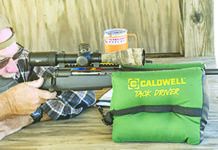
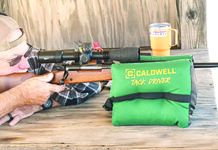
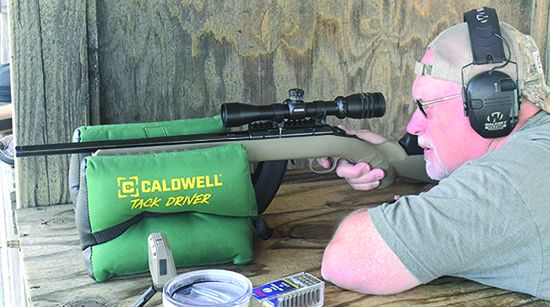
We shot for group and function using three different types of ammo, all available from MidwayUSA.com. The first were 30-grain varmint loads with polymer tips from CCI. The second was a 40-grain total-metal-jacket Target load, also from CCI. The last was a 40-grain Gold Dot hollow-point load from Speer. Our team tested at American Shooting Centers in west Houston. We supported the rifles in a Caldwell TackDriver Pro (Brownells 100-027-023, $49), further supported by a large rear bag, heavy from Tab Gear (TabGear.com, $34). We fired three-shot groups at 50 yards. We measured velocities with a Garmin Xero C1 Pro (Garmin.com, $600). For optics, we used a Redfield Battlezone Tac-22 scope with 2-7x34mm magnification, $250.
Written and photographed by Joe Woolley, using evaluations from Gun Tests Team members. GT