











Living in an apartment or condo adds an important constraint: overpenetration risk. You need to stop a threat without sending projectiles through walls into neighboring units.
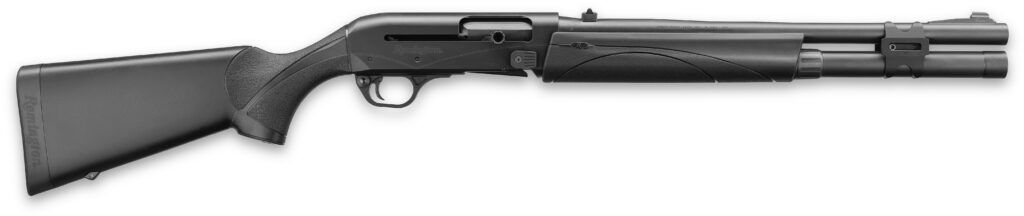
The best shotgun platforms for the task are the Mossberg 500/590 series or Remington 870 variants. Both are pump-actions, so they’re reliable and don’t have cycling issues with reduced-recoil loads, which are covered below.
Also, both are widely available, affordable, and proven, and they come in easy-to-find 18″–20″ barrel configurations ideal for indoor use.
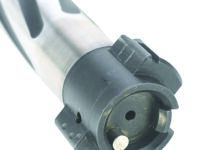
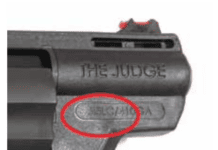
Another type is shot shell-firing guns, such as the Mossberg 590 Shockwave, which has a 14″ barrel and a pistol grip. It isn’t a shotgun but is rather a shot shell-firing gun under ATF rules, which allows it to have the short smoothbore barrel. Though it is compact, it is harder to control and less recommended for most people.
For an apartment, a 20″ or 18.5″ barrel is the practical sweet spot — maneuverable in hallways without being so short that it’s harder to control.
Best Load for Apartment/Condo Defense
This is where it gets really important. Your priority order should be:
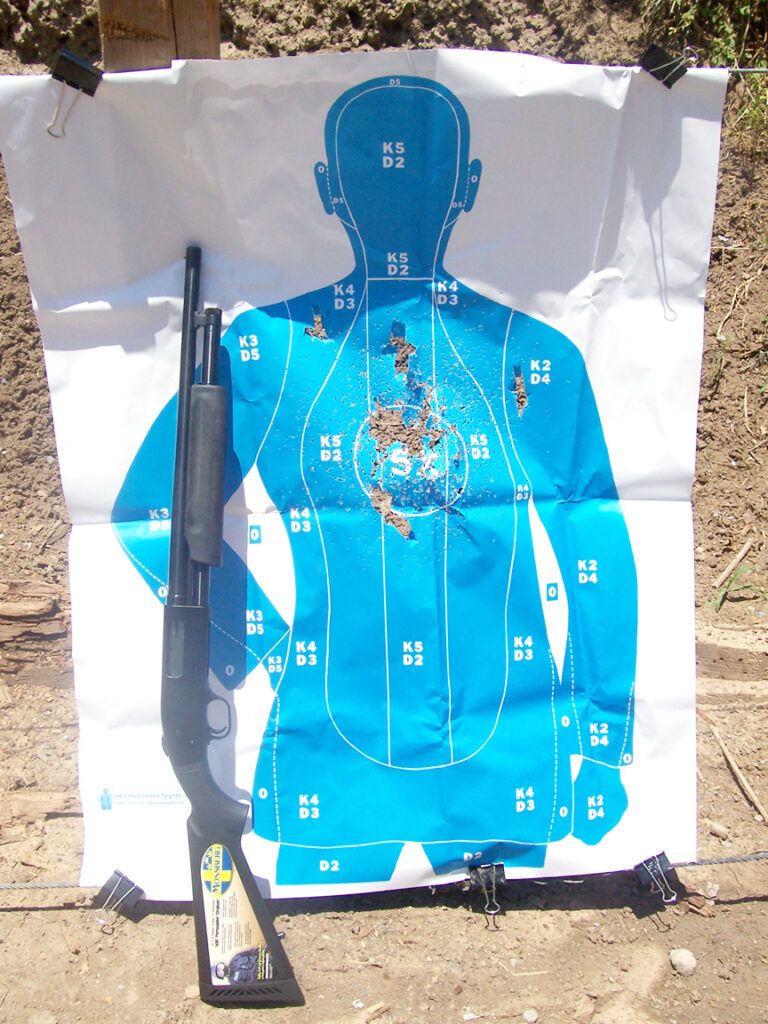
#1 Recommendation: Reduced-Recoil #1 Buckshot ✅ Best balance
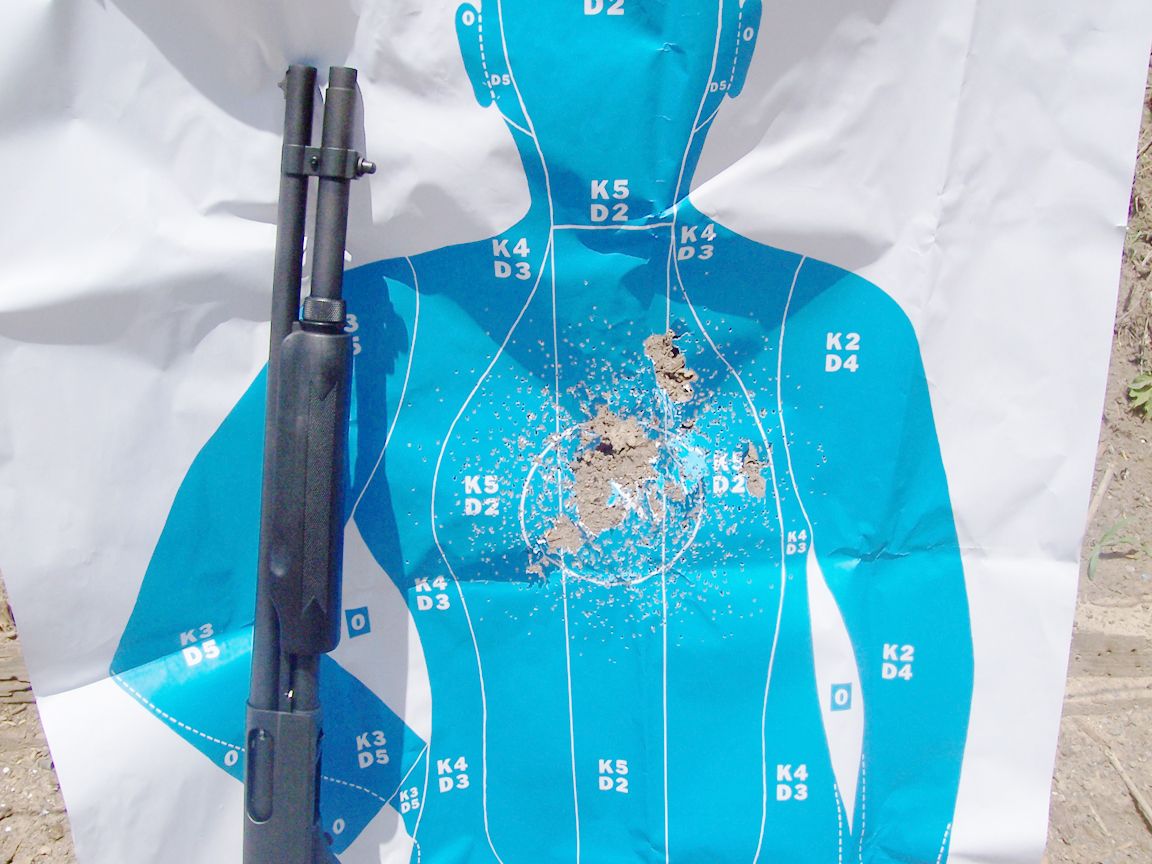
#1 buck (.30-caliber pellets, typically 15–16 pellets in a 2¾” shell) offers excellent terminal performance but penetrates significantly less than 00 buck through drywall. Federal, Fiocchi, and Remington all make reduced-recoil versions. They are the sweet spot between stopping power and wall penetration.
#2: Reduced-Recoil #4 Buckshot ✅ Great choice
Smaller pellets (.24 caliber, ~27 pellets) have even less drywall penetration than #1 buck, but is still very effective at typical indoor distances (under 15 feet). It’s a common recommendation specifically for multi-unit dwellings.
What About 00 Buck?⚠️ Risky
Standard 00 buckshot is the classic law enforcement load, but each pellet is essentially a .33-caliber projectile. Tests show it can penetrate multiple layers of drywall — a serious concern when neighbors are on the other side of your walls.
If you prefer 00 buck, Federal FliteControl wad technology (⚠️ Acceptable) keeps the pattern tight and reduces individual pellet energy slightly, making it a better option than standard 00 if that’s your preference.
What About Slugs? ❌ No
Avoid slugs entirely for apartment defense. A single 1 oz. slug will blow through walls, doors, and potentially multiple units. These are hunting/outdoor loads.
What About Birdshot? ❌ Unreliable
Birdshot (#7, #8, #9) is often suggested because it “won’t overpenetrate,” but this is a myth for defensive purposes. At close range it acts like a solid mass and can still penetrate walls, but more importantly, it may lack the tissue penetration needed to reliably stop a threat. Not recommended as a primary defense load.
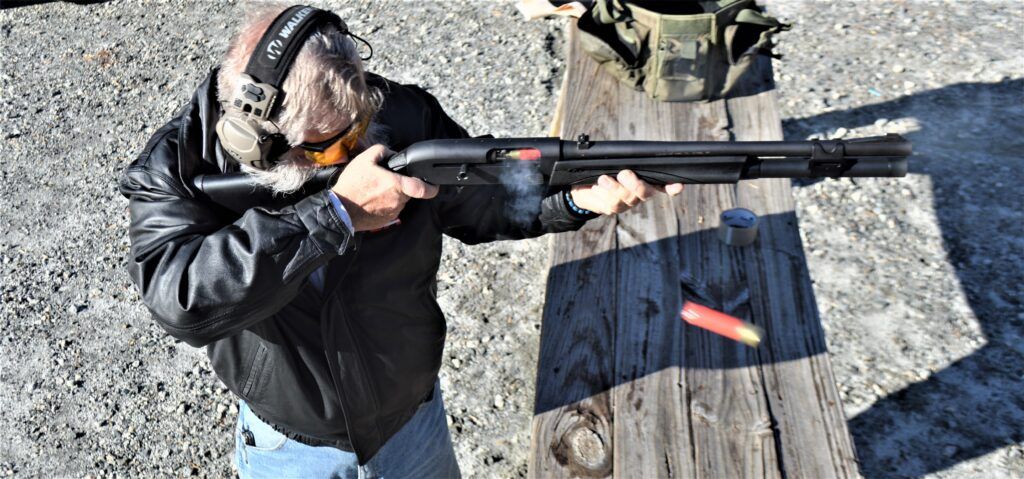
Bottom line: A Mossberg 500 or Remington 870 with an 18.5″–20″ barrel, loaded with reduced-recoil #1 or #4 buckshot, is the most responsible and effective combination for apartment or condo home defense.
More on Overpenetration
The fear of a projectile carrying far past the area of a gun battle is real. Wounds received by innocent persons who happen to be in the wrong place at the wrong time are not uncommon. However, most of these occur in the open or on the street and are a result of missed shots, rather than overpenetration.
So, incidents involving apartment dwellers and condo owners firing through walls and a bullet exiting the living space and causing damage, injury, or death are rare. The same is true for injuries caused inside the apartment. We believe this is because the vast majority of armed citizens are mature, conscientious individuals.
Beyond Marksmanship
Next, knowing the distance between one occupied structure and the next nearest one is helpful, because distance robs errant shots of power and trajectory, because we usually fire at an angled attitude, slightly up or slightly down and seldom perpendicular to the target. Thus, chances are the bullet will come to rest in something before it reaches another occupied apartment. The bullet may strike the ceiling, or it may dig into the floor.
Also, it’s important to realize how ridiculous cinema depictions of gun-battle participants using a chair or mattress for cover really are. Bullets zip right through these constructs. Some furniture may be heavy enough to turn a bullet, and the pine-board results are a good way to estimate those effects without having to shoot up the walnut dining-room table.
Common building materials in apartments and condos are wallboard and pine boards.
It should be no surprise that bullets, slugs, and buckshot go through wallboard — it’s just paper and clay. Other generic names are plasterboard and gypsum board. Common product names are Sheetrock and Gyproc. As one of the raters noted, there is no magic bullet that will not penetrate this material in the home and relieve you of the responsibility of aiming straight.
Pine boards were once a universal testing medium, and they only measured penetration. Smaller shot is often defeated by pine boards. The issue with smaller shot is the one or two pellets that slip past a board and only encounter wallboard.
Also, one of the considerations never mentioned in the popular press is the existence of firewalls between walls in apartment complexes. Building and structural firewalls in North America are usually made of concrete, concrete blocks, or reinforced concrete. These structures are very good at stopping or slowing down smaller projectiles.
If you choose a shot shell-firing gun for defense in your apartment or condo, we recommend getting competent training with it and practice shooting on a regular basis, including basic manipulation drills (racking, loading, safety manipulation, and so on), plus low-light shooting, if it’s available to you.
Also, we recommend getting instruction on the legal issues associated with lethal self defense. Training and practice will help you be better prepared to handle your gun safely and correctly if you’re ever required to use it.
Read More from Gun Tests (all are free)
Sub-Gauge Shockwaves Go Up Against Remington’s TAC-14
Mossberg 590 Shockwave 50659 12 Gauge
Mossberg 590S Shockwave 51601 12 Gauge
Remington 870 TAC-14 81230 12 Gauge
12-Gauge Mini Shells from Federal, Aguila, and Nobel
Henry Lever Action Brass Axe H018BAH-410 .410 Bore 2.5 in.
5 Best Shotguns for Self-Defense 2025
12-Gauge Buckshot for Home Defense: We Shoot Nineteen (June 2021)
12-Gauge Mini Shells from Federal, Aguila, and Nobel (August 2020)
What About the 20 Gauge for Home and Personal Defense? September 2016
Shotgun Defense Choices: We Pick Two Fiocchi Loads, November 2011