














The Marlin 336 Series Lever-Action Rifles
Savage 110 GXP3 .223 Remington, $449
Working the Savage 1899 Rifle
In 1893, Savage patented the first truly hammerless lever-action rifle. This streamlined rifle differed from the Winchester and Marlin lever-action rifles of the same era in that it used a rotary magazine that allowed the use of ballistically superior pointed-nose bullets. All of the other lever-actions of this period used a tubular magazine. The tubular magazine meant that cartridges were fed into the tube with bullet nose to primer, necessitating the use of blunt-nosed bullets to avoid a chain-fire situation. By 1895, Savage's rifle was in full production as the Model 95. Around 1899, a few small design improvements were made and, since then, the design has remained relatively the same—one of the "bread and butter" firearms of this company.
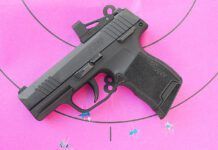
Springfield Loaded Model PX9109LP 45 ACP, $1035
Remington 11-87 Sportsman No. 29825 3-inch 20 Gauge
One of the major reasons hunters choose a 20 gauge over a 12 gauge is the former's smaller frame, weight, and recoil. Though they may already own a 12, many field sportsmen wind up reaching for their 20s because the smaller gun is just easier to handle, and there are just a few hunting situations—layback goose hunting and spring turkey hunting, to name two—in which the bigger payload might make a difference.
The Remington Sportsman line has two 12s and three 20s. The 12s come in 26- and 28-inch barrels and weigh 8.1 pounds and 8.25 pounds respectively, compared to the weight of our test 28-inch-barrel gun, about a full pound lighter.
Ruger MKIII6 Standard .22 LR
Working the Browning Model 81 Lever-Action Rifle
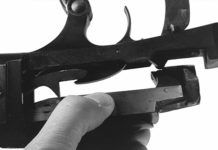
I must admit that Browning has one strong reason in its favor for not telling the company's customers how to take their BLRs apart. Disassembling and reassembling this rifle should only be done by a knowledgeable, qualified gunsmith—even for cleaning—because doing it incorrectly may cause damage to parts. So Browning chooses to avoid all references to taking the gun apart. In fact, it says in the gun's manual, "If your rifle requires service, contact your local recommended Browning Firearms Service Center." This means gun shops will be getting these rifles in for repairs and cleaning, and you need to know how to take them apart the right way, or you will find yourself telling your customer that you are sorry, but he is going to have to wait until a new part arrives. Here's what you need to know about fixing the lever-action Model 81 Brownings:
Glock G34 9mm
According to the manufacturer, the Glock pistol was the first "industrially manufactured handgun with high-tech polymer grips." The barrels and slides are coated with what Glock describes as a "high-tech surface refinement" that they call Tenifer. The benefits of this "carbonitriding" coating are not only corrosion resistance and reduced glare but also resistance to abrasion. Tenifer coating is highly rated on the Rockwell Cone hardness scale at 64 HRC.
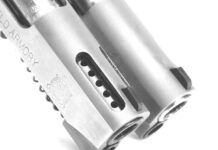
Some Glock pistols are available with different color frames, but our G34 was basic black. The defining feature of the G34 was its long 5.3-inch barrel with polygonal rifling, covered by a slide that included a gaping hole just to the rear of the front sight. This relief measured approximately 1.75 inches long by 0.75 inches wide. Glock says that this serves to reduce stress on the frame. The dustcover beneath the slide was also longer, making room for a healthy sized accessory rail, which was molded into place. The schematic breakdown of the Glock pistol with magazine lists only 34 separate parts, 36 if you count the magazine insert at the base plate (part 32a), and the front sight blade, part number 16a.
Springfield Armory Milspec PB1132 38 Super, $682
The Mil Spec model is in some ways a commemorative pistol without getting gaudy or expensive. It has classic styling including a basic military style grip safety and solid hammer tang.
Bushmaster Patrolman’s Carbine .223 Rem., $1230
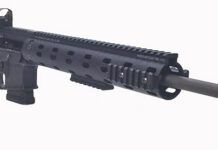
Our Bushmaster Patrolman’s Carbine was yet another interpretation of the flat-top AR. The base price of this model was $1230 including the Fiberite Six Position adjustable stock and A2 front sight. But we picked several options to bring it into spec with our other carbines. A 4 Rail Free-Floater Forend (YHM-9479) was in place plus an Ergo Sure Grip (ARG- KIT). With another Ergo Sure Grip clamped to the bottom forend rail (ARG-FWD), we thought we were seeing double.
The forend grip could be placed anywhere along the bottom rail as long as it was far enough forward to clear the magazine. A large knob with a coin or screwdriver slot and knurled edges held the grip in place. With two pistol style grips in place, our stance took on a narrower profile. This would be especially advantageous when traveling down a hallway or taking cover in a tight space. The forend itself appeared to be fatter. This was because the rails were covered with slip-on Sure Grip rail covers featuring the Bushmaster logo, (SCH-6L). The rail covers created a smooth, rounded feel to the forend and increased its overall width by about 0.3 inches.
Ruger Hawkeye Tactical HM77VLEH 308 Win., $1172