







Mossberg introduced the 590 Shockwave 12-gauge pump firearm in 2017, and a variety of different shotgun manufactures copied the idea and created their own version of these guns that are classified as firearms, and not shotguns, by the ATF. Recently, Mossberg applied the Shockwave treatment to a semi-auto firearm and called it the 990 AfterShock. Citadel, a brand by Legacy Sports International, has a version of the original 590 Shockwave and calls it the Tidalwave. We wanted to revisit these firearms — humor us as we call them shotguns going forward — and take a look at the difference between semi-auto actions versus pump actions, covering the operational differences well as tactical differences. We found there are many pros and cons with these types of firearms.
The AfterShock and Tidalwave are both chambered for 3-inch 12-gauge shotshells and equipped with a 14.7-inch barrel and have an overall length of about 27 inches. The AfterShock is a semi-auto and the Tidalwave is a pump. The other big difference is the price. The Mossberg’s price hovers around $900, while the Citadel costs about $325. They are designed for close-up defense work and shine in cramped environments where maneuverability is paramount. Hallways, pie-wedging around corners, creeping down steps, you get the idea. These firearms offer the full blast of a 12-gauge shotgun, but without the length, and that’s an advantage and disadvantage.
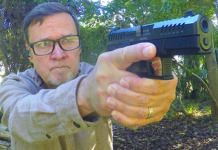
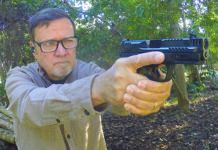
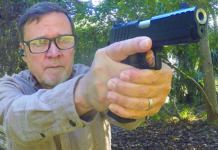
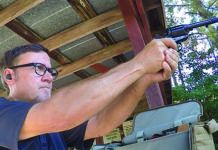
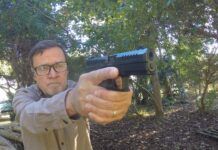
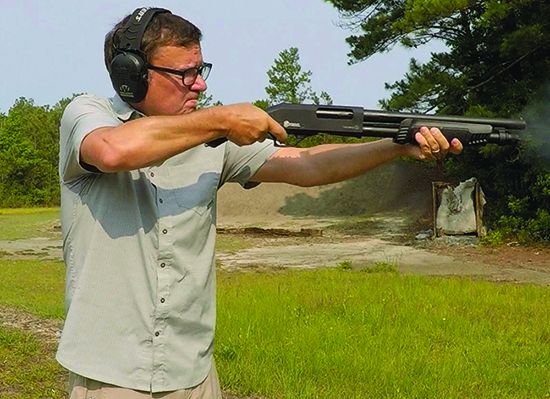
First, the downsides. These firearms are difficult to shoot. You can’t hold them like a handgun nor use them like a rifle. We found it hard to get a steady aim with the Tidalwave and AfterShock. Shooting them from the hip or side of our torso was difficult to aim, but with practice, we were able to get solid hits on the target. Holding the firearms in front of our body at arms length offered better accuracy. We used the push-pull technique — pull the grip with the firing hand while pushing with the support hand — to steady the firearm and made sure the firearm was away from our face during recoil.
Also, the Mossberg and Citadel both generate 12-gauge recoil, which flips the muzzle up and the grip back. Hold them firmly with both hands to avoid getting whacked with the firearms during recoil.
On the upside, they have power. We used three defense loads and birdshot to collect pattern sizes. For defense loads, we opted for 00 and 0B buck shot. Both Hornady Critical Defense and Panzer Defense are loaded with 00 buckshot, and Aguila is packed with 0B buckshot. For the birdshot load, we used Federal Ultra Clay & Field shotshells loaded with 11⁄8 ounce of No. 8 birdshot. For home defense, 00 buckshot sounds like the most practical choice, but it can overpenetrate and go through the walls in your home. Birdshot can be an alternative because No. 8s do not have the individual shot energy like buckshot. The disadvantage with birdshot is the pattern can be large, and some shot will fly past the target. We used IPSC and D-1 targets to judge pattern spread and set the targets at 15 yards. How did we weather the stormy shooting the Tidalwave and AfterShock offered? Here are the details.
Citadel Tidalwave CBSTW1214 12 Gauge,
$324
Gun Tests grade: B
The Tidalwave had initial FTE jams, and shells stuck in the magazine tube. Those issues worked themselves out after break in. The fore end needs a strap for better control and a heat shield on the barrel for support-hand protection.
| Action Type | Pump |
|---|---|
| Chamber Size | 3.0 in. |
| Overall Length | 27.0 in. |
| Capacity | 5+1 |
| Weight Unloaded | 5.2 lbs. |
| Weight Loaded | 6.4 lbs. |
| Barrel Length | 14.7 in. |
| Choke | Cylinder Bore, fixed |
| Finish | Matte black |
| Choke | Fixed, cylinder bore |
| Grip | Polymer with rubber finger rests |
| Fore End | Textured polymer |
| Sights | Brass bead |
| Trigger Pull Weight | 4.9 lbs. |
| Safety | Manual trigger block |
| Warranty | 7 year |
| Telephone | (800) 553-4229 |
| Website | CitadelFirearms.com |
| Made In | Turkey |
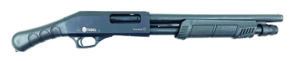
The Tidalwave is a manually-operated slide-action firearm that’s chambered in 12 gauge. It is manufactured by Akdal Arms, LLC, in Turkey and imported by Legacy Sports International under the Citadel brand. Overall length is 27 inches. Specs say the barrel length is 14.7 inches, but the barrel is roll marked 14.5 inches. Suffice it to say we measured it and it is 14.7 inches. The other two-tenths of an inch must have gotten lost in the translation.
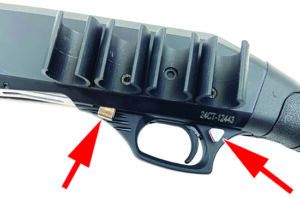
The barrel uses a fixed Cylinder-bore choke and a plain brass bead as the front sight. The metal wore a nice matte-black finish. The trigger guard is polymer and has a modern-looking squared-off trigger guard. The manual safety is a triangular-shaped button that blocks the trigger. It is easy for a right-handed shooter to use the safety. The action bars lock is a small silver-finished tab just forward of the trigger guard. It needs to be pressed when the Tidalwave is empty and the slide is fully forward. Pressing it allows the slide to be pulled rearward to drop a shell in the chamber, pump the slide forward, and then insert shells through the loading port. There is also a 3⁄8-inch dovetail milled on the top of the receiver to mount an optic. In our opinion, an optic on a firearm like this places the butt of the grip close too close to your face. You would need plenty of practice and training to avoid whacking yourself in recoil.
The fore end has a light texture with a lip on each end that, in theory, helps to keep your hand in place when pumping the slide. We wanted a strap here and more texture so our hand would not slip on the fore end when we fast-pumped the Tidalwave. The grip is the same hard polymer with three textured finger holds. This needs more texture, too. In the butt of the grip is a sling stud for a sling, which we liked. The magazine cap also has sling stud.
On the left side of the receiver is a polymer shell holder that is attached to the Citadel via the trigger group pins and holds four shells. We liked the ability to carry extra ammo on the Tidalwave. We placed shells brass up and brass down in the shell holder and reloaded from the holder. We found that brass down was the most efficient way to arrange shells to load. We did note that shells moved in the holder during recoil, but no shells fell off during recoil. The tubular magazine holds five shells.
In hand, the Tidalwave is lithe. It only weighs 5.2 pounds, so it was more lively in hand than the Mossberg. The trigger-pull weight was a heavy 5 pounds, which is typical for a shotgun. There was no take up on the trigger, and it broke fairly cleanly.
The loading port was narrow, like a typical hunting shotgun, making it a bit slower to re-load. We pinched our thumb once on the carrier and learned our lesson. Since the Tidalwave is lighter, we were able to load with our support hand, stripping out shells from the holder while our firing hand held the grip. We also cupped the receiver top side down in our firing hand to load from the shell holder. We needed to manage barrel heat while holding the gun.
The Tidalwave had an initial hiccup. The carrier latch jammed and would not let a shell move from the magazine tube. We needed a long screwdriver to press the latch and allow the shell to move from the magazine tube and onto to the carrier. This didn’t happen again.
We then experienced the fore end sticking fully forward, making it hard to pump the slide to eject an empty shell. This happened when firing the heavier defense loads. After about 25 rounds, the slide smoothed up, and we had no further issues. We suspect the mishaps were due to the Tidalwave not being broken it. By the end of the test, the firearm was running smoothly with no more issues.
We found the patterns with the Tidalwave were larger than the AfterShock. With the bird-shot, the average pattern size was 22 inches. The defense load averages for the Aguila, Panzer, and Hornady were 8, 7, and 4 inches, respectively.
There was more felt recoil with the Tidalwave, but it is mainly in your arms, not your palm, not your shoulder. We could fire the Tidalwave pretty fast and still maintain accuracy toward the end of the review, but not at the speed of a semi-automatic. At times, our support hand slipped off the fore end during recoil. A strap or more non-abrasive texture on the fore end would be a great improvement.
Our Team Said: The Citadel ran well after break-in. We liked the shell holder and the ability to carry 10 rounds of ammo on the firearm. The fore end was slick, and if we owned this, we would add some non-abrasive anti-slip tape for added traction. If you want to get into one of these firearms, the Tidalwave is an inexpensive option.
| 12-GAUGE RANGE DATA | ||
|---|---|---|
| Hornady Critical Defense 8 Pellets, 00 Buckshot 86240 | Citadel Tidalwave | Mossberg 990 AfterShock |
| Average Pattern Size | 4 in. | 3 in. |
| Federal Ultra Clay 11⁄8 oz. No. 8 Shot 3 Dram Eq. UC 12SI 8 | Citadel Tidalwave | Mossberg 990 AfterShock |
| Average Pattern Size | 22 in. | 21 in. |
| Aguila High Velocity 12 Pellets, 0B Buckshot 13⁄8 oz., 1C1200BA | Citadel Tidalwave | Mossberg 990 AfterShock |
| Average Pattern Size | 8 in. | 7 in. |
| Panzer Defense 9 Pellets, 00 Buckshot 13⁄16 oz., 3¾ Dram Eq. | Citadel Tidalwave | Mossberg 990 AfterShock |
| Average Pattern Size | 7 in. | 4 in. |
To collect pattern data, we fired off hand at a distance of 15 yards. All shotshells were 2¾-inch loads. Hornady Critical Defense factory velocity = 1600 fps. Federal Ultra Clay factory velocity = 1200 fps. Aguila High Velocity factory velocity = 1275 fps. Panzer Defense factory velocity = 1350 fps.
Written and photographed by Robert Sadowski, using evaluations from Gun Tests Team members. GT